
Marketing Attribution Without the Holy War
Stop fighting over last-touch vs multi-touch attribution. Agree on a model both teams can live with and use it to make decisions, not assign blame.
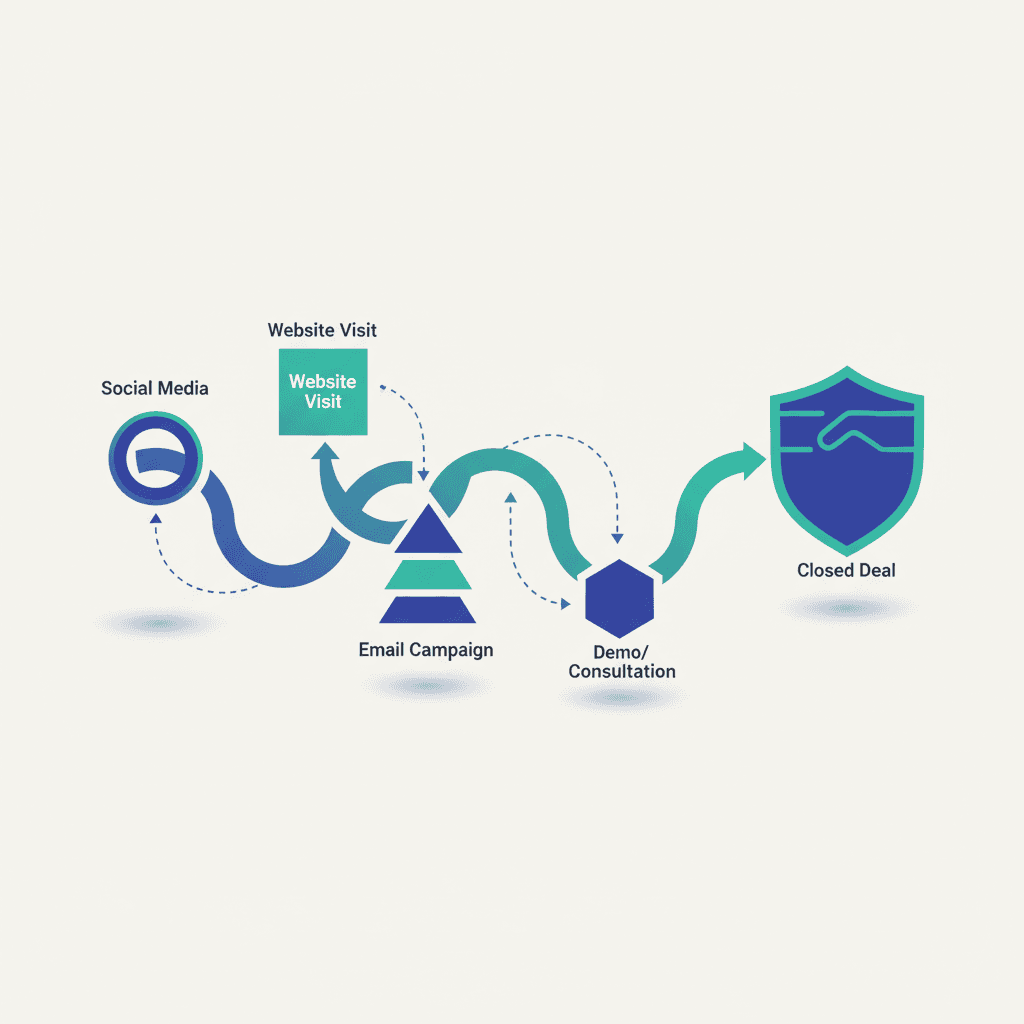
The deal closed for $120,000. Then the war started.
Marketing pulled up the report showing the buyer had downloaded three guides, attended a webinar, and clicked four nurture emails before ever talking to sales. Attribution earned, they said. Sales pulled up a different view: the deal moved because a rep made nine calls, ran a custom demo, and personally talked the champion through a security review. The marketing touches were noise, they said. Tire-kicking.
Both were right. That was the problem. They were not arguing about the deal. They were arguing about a model, and the model they each chose happened to make their own team look indispensable.
This is the attribution holy war, and it has killed more sales-marketing alignment than any blown quarter. The fight is unwinnable because there is no true answer. Attribution is a model, not a measurement, and the goal was never accuracy. It was confidence to make the next decision.
Why the War Is Unwinnable
Last-touch attribution gives all the credit to the final interaction before the deal. Multi-touch spreads credit across every touch. First-touch credits whatever started it. Each is a defensible lens. Each is also, technically, wrong, because no model can know what was actually decisive inside a buyer's head.
Gartner's research on the B2B buying journey has made this point for years: buyers move through a messy, nonlinear set of interactions, much of it invisible to your systems. A buyer reads a competitor comparison, asks a peer on Slack, sees a LinkedIn post, and none of it shows up in your CRM. Any attribution model is a simplification of something fundamentally unobservable.
Attribution is a model, not a measurement. The moment you treat it as truth, you have armed both teams with a weapon. The moment you treat it as a shared lens, you have given them a tool.
So if no model is correct, what are we even doing? We are choosing a consistent, agreed-upon way to see the funnel so we can compare this month to last month and decide where to spend the next dollar. Consistency beats accuracy. A flawed model both teams trust is worth more than a perfect model one team rejects.
The Pragmatic Stance
Here is the stance that ends the war. Pick one primary model for reporting and decisions. Allow secondary models as context. Forbid using attribution to assign individual blame.
Read that last sentence again, because it is where alignment actually lives. The damage from attribution does not come from the math. It comes from the moment a leader uses the report to say "this team is not pulling its weight." The instant attribution becomes a blame instrument, every number becomes a thing to be gamed rather than trusted.
The teams that get this right treat attribution like a thermostat, not a referee. It tells you whether the room is getting warmer or colder. It does not decide who wins the argument.
HBR has written about how shared metrics fail when they are tied to individual judgment rather than collective learning. The same metric can build trust or destroy it depending entirely on what you do with it. Attribution is the clearest example in the GTM stack.
Choosing a Model You Can Both Live With
You do not need the sophisticated model. You need the one both teams will actually accept. Here is how the common models trade off:
| Model | Best for | Watch out for |
|---|---|---|
| First-touch | Understanding what creates demand | Ignores everything that closes the deal |
| Last-touch | Crediting what converts | Ignores everything that created the deal |
| Linear multi-touch | A balanced, simple shared view | Treats a throwaway click like a demo |
| Time-decay multi-touch | Weighting recent touches more | More complex to explain and trust |
| Self-reported ("how did you hear?") | Capturing invisible influence | Messy data, requires discipline to use |
For most teams in the 10-100 person range, the honest recommendation is a simple linear or time-decay multi-touch model as the primary lens, paired with a self-reported field on key forms to catch the dark funnel. SaaStr and a lot of operators have converged on the same uncomfortable truth: the "how did you hear about us?" question, used consistently, often outperforms the expensive attribution tooling, because it captures influence your tracking never will.
The point is not which row you pick. The point is that you pick one, together, on purpose, and write down why.
The Artifact: An Attribution Decision Framework
This is the document that ends the recurring fight. Fill it out once, together, and refer back to it every time someone wants to relitigate. Copy it.
ATTRIBUTION DECISION FRAMEWORK

1. PRIMARY MODEL (used for reporting + budget decisions)
   We use: ______________________ (e.g., linear multi-touch)
   Because: ____________________________________________
   Signed by: Sales lead ________  Marketing lead ________

2. SECONDARY MODELS (context only, never for decisions alone)
   [ ] First-touch  -> answers: what creates demand?
   [ ] Last-touch   -> answers: what converts?
   [ ] Self-reported -> answers: what influence did we miss?

3. RULES OF ENGAGEMENT
   [ ] Attribution informs WHERE to spend, not WHO to blame
   [ ] No individual rep or campaign is judged on attribution alone
   [ ] We compare periods using the SAME model, always
   [ ] Model changes require both leads to sign off
   [ ] Dark-funnel influence is assumed real even when untracked

4. WHAT EACH DECISION USES
   Budget allocation        -> Primary model + self-reported
   Channel performance      -> Primary model, trended over time
   Campaign go/no-go        -> Primary model + pipeline influence
   Rep performance          -> NOT attribution. Use activity + outcomes.

5. REVIEW
   We revisit this model every: ______ (e.g., 2 quarters)
   We do NOT change it mid-period to win an argument.
The signatures matter more than the model choice. When both leaders have signed, the next time someone says "but the deal really closed because of X," the answer is "we already decided how we measure this, and here is the doc." The argument is over before it starts.
Use It to Decide, Not to Defend
Once the framework is signed, attribution becomes useful instead of toxic. You can ask real questions: which channels create pipeline that actually closes? Where is spend producing volume but not revenue? Which campaigns influence deals that sales would not have found alone?
Gong and similar conversation tools can add a layer here by showing what buyers actually talk about, which is a useful reality check against whatever your touch data claims. But conversation data is also a model. It is another lens, not the verdict. Hold all of it loosely.
The teams that win stop asking "who gets credit?" and start asking "what should we do more of?" That shift, from defending to deciding, is the entire point.
Where Attribution Sits in the System
Attribution is one piece of a larger alignment system. It only works when the definitions underneath it are solid, which is why we recommend nailing your MQL and SQL definitions and your sales and marketing SLA first. Attribution built on fuzzy definitions just gives both teams sharper weapons.
If your pipeline data is unreliable, no attribution model will save you, so it is worth pairing this with solid pipeline hygiene and forecasting practices.
The ready-to-use version of the framework above lives in our templates library, and the full set of alignment docs is in the GTM toolkit.
End Your Holy War
You will not find the perfect model, because it does not exist. You will find a good-enough model both teams trust, and that is worth far more.
Sit your sales and marketing leads down, fill out the framework, get the signatures, and move on to the work that actually grows revenue. If you want to see how other operators settled this, the threads in r/b2bmarketing are a candid place to compare notes. Share your primary model and why you chose it. The reasoning is usually more instructive than the model itself.
Put this to work
Build a custom version in the toolkit, or grab a ready-made template.